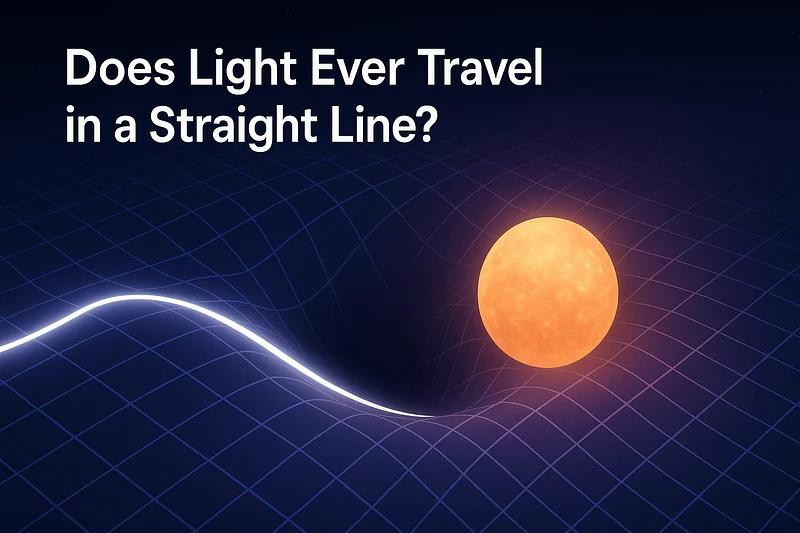
“If light always moves in a straight line, why does it seem to curve around stars?”
That was the question I found myself asking as I dug deeper into the nature of the universe. What started as idle curiosity turned into a deep dive into the fabric of spacetime, Einstein’s equations, and how light — the fastest thing in existence — is actually not as straightforward as it seems.
🤔 Setting the Scene: My Initial Question
It all started with a simple but persistent itch: “Does light really travel in a straight line?” Sure, in high school physics we draw rays as straight lines — lasers cutting clean across diagrams. But in space? In curved spacetime? Near black holes? The answers started to bend.
So I asked ChatGPT:
“Does light ever travel in a straight line — or is it always curving somehow?”
The response pulled me straight into General Relativity.
🌀 Geodesics: The Real “Straight Lines” of Spacetime
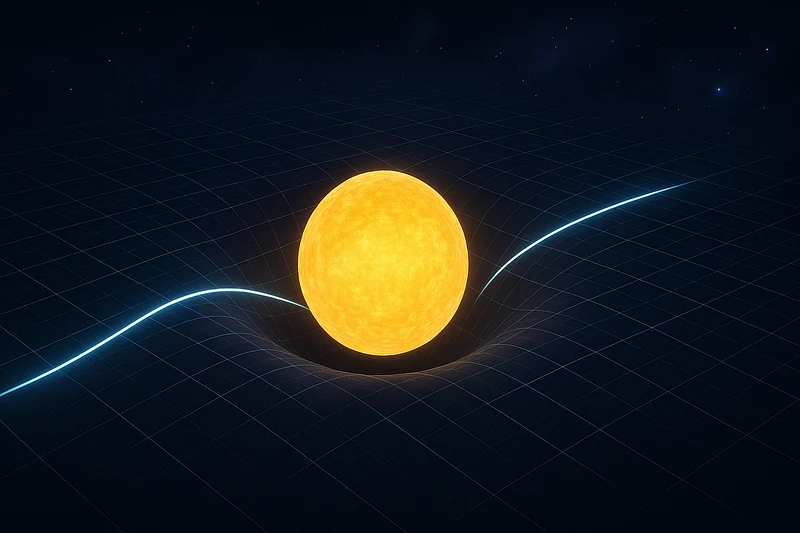
In flat Euclidean space, a straight line is the shortest path between two points. But our universe isn’t flat — it’s curved by mass and energy. And in curved spacetime, the straightest possible path is called a geodesic.
Light always follows a geodesic. That’s not a poetic metaphor — it’s a hard mathematical rule.
📐 What’s a Geodesic?
Think of a geodesic as the closest thing to a “straight line” on a curved surface. Imagine you’re on a globe — like the Earth. The shortest path between two cities isn’t a straight line on the map, but a great circle route. Airlines use these routes to save fuel, even though they look curved on flat maps.
Now, picture a marble rolling on a trampoline. If you place a heavy bowling ball in the centre, the trampoline dips, curving the surface. The marble will roll along paths that seem curved when viewed from above, but on the trampoline’s surface, it’s following the straightest possible line — a geodesic.
Spacetime works similarly, but instead of a 2D surface, it’s a 4D fabric curved by mass and energy. Light, like our marble, follows these geodesics.
🛰️ Geodesics and GPS Satellites
Here’s a real-world twist: GPS satellites rely on geodesics too. They orbit Earth and send signals to your phone. But because Earth’s gravity curves spacetime, the satellites’ paths and the signals they send aren’t perfectly “straight” in the classical sense. Engineers must correct for these effects to keep your GPS accurate to within meters.
The Geodesic Equation
The geodesic equation in general relativity is:
d²x^μ/dτ² + Γ^μ_{νσ}(dx^ν/dτ)(dx^σ/dτ) = 0
Where:
x^μare the spacetime coordinates,τis the affine parameter (like proper time),Γ^μ_{νσ}are Christoffel symbols — which describe how spacetime bends.
This equation tells us how objects move when no forces act on them, except gravity — which here is geometry itself.
🌌 Einstein’s Field Equations (Don’t Panic)
To understand how light bends, we need to understand what’s causing the bending: spacetime curvature.
Einstein’s field equations relate mass and energy to the curvature of spacetime:
G_{μν} + Λg_{μν} = (8πG / c⁴) T_{μν}
Simplified Derivation Logic
At its core, Einstein wanted to generalise Newton’s law of gravity — which says mass pulls on mass with a force — into something that works at high speeds and in strong gravity. Newton’s law treats gravity as a force acting at a distance. Einstein flipped this on its head: gravity isn’t a force but the shape of spacetime itself.
G_{μν}is the Einstein tensor, representing spacetime curvature.T_{μν}is the energy-momentum tensor, representing all matter and energy.Λis the cosmological constant, accounting for vacuum energy or dark energy.g_{μν}is the metric tensor, describing the geometry of spacetime.Gandcare the gravitational constant and speed of light.
Einstein’s genius was to link the geometry (G_{μν}) directly with the content of the universe (T_{μν}). The result? Mass and energy tell spacetime how to curve, and curved spacetime tells mass and energy how to move.
Newtonian Limit
In weak gravity and low speeds, Einstein’s equations reduce to Newton’s law of gravity. This means Einstein didn’t discard Newton — he expanded it. So when you throw an apple or launch a satellite, Newton’s gravity is still a great approximation.
But near black holes or at cosmic scales, only Einstein’s equations give the full picture.
⏱️ Shapiro Delay: Gravity Slows Light (Sort Of)
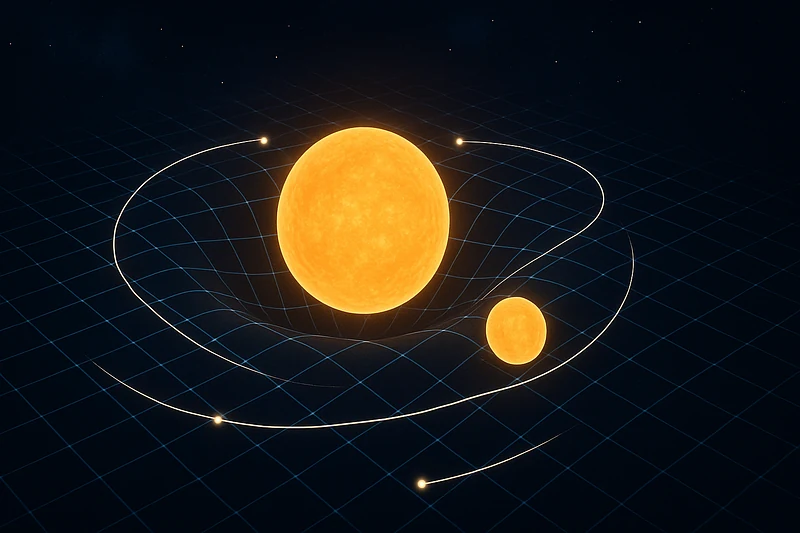
Here’s something that blew my mind: Light doesn’t just bend near massive objects. It also appears to slow down when passing near them. Not in the usual “speed = distance/time” sense — the coordinate time it takes increases.
Coordinate Time vs Proper Time
This is where things get subtle. In relativity, proper time is the time measured by a clock moving along with an object. For light, proper time is always zero — it doesn’t experience time.
Coordinate time, on the other hand, is the time measured by a distant observer, like us watching from Earth.
Near a massive body, spacetime is curved so that the coordinate time taken for light to travel a given path is longer than it would be in flat space. This is the Shapiro Delay, first predicted in 1964 by Irwin Shapiro.
Example: Radar Signals and Time Dilation
Imagine bouncing a radar signal off Venus when it’s behind the Sun. The signal travels through curved spacetime near the Sun, so it takes longer to return than Newtonian physics would predict.
This delay is a direct consequence of gravitational time dilation — clocks run slower in stronger gravitational fields. So to us, the light signal is “slowed” because it’s passing through regions where time itself is stretched.
This effect has been measured — most famously by:
- The Viking Mars mission in the 1970s
- The Cassini probe in 2002, with ultra-precise radio tracking
These measurements confirmed Einstein’s predictions with remarkable accuracy.
🌞 1919 Eclipse: First Proof of Curved Light
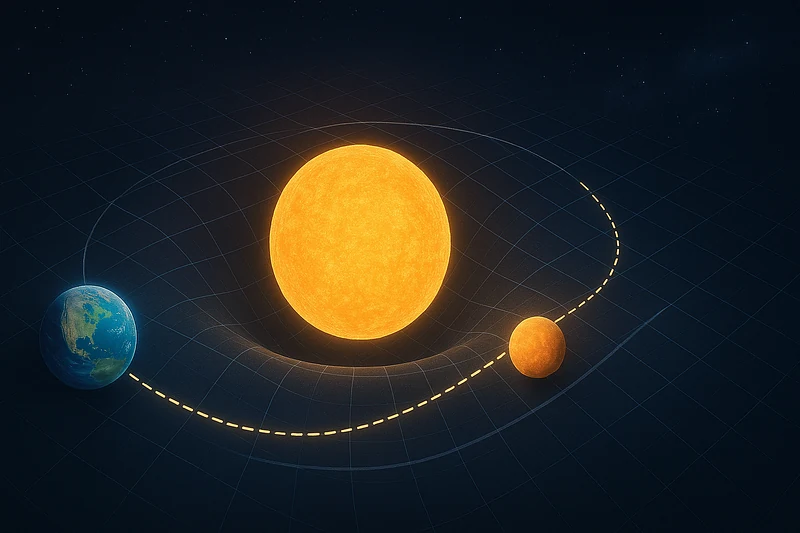
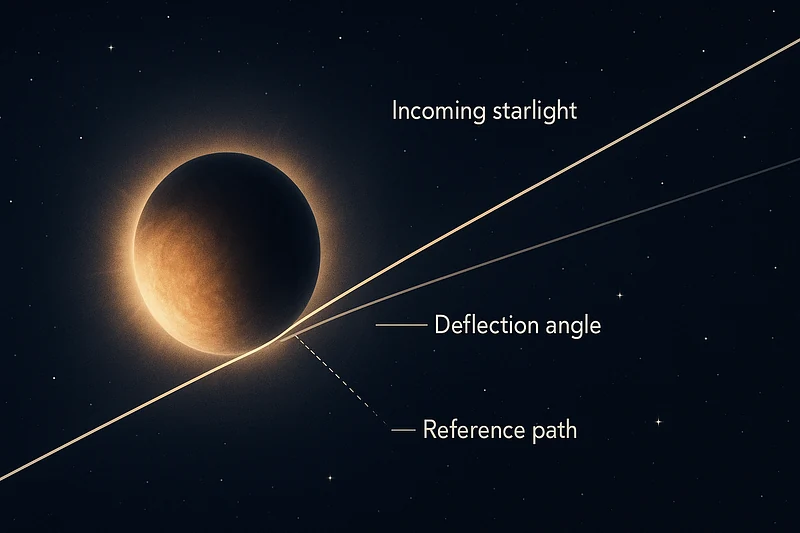
One of the first confirmations of Einstein’s theory came during a solar eclipse in 1919.
British astronomer Arthur Eddington measured the apparent positions of stars near the Sun during the eclipse. Their positions had shifted — not because the stars moved, but because their light was bent by the Sun’s gravity.
The deflection angle matched Einstein’s prediction:
δφ = 4GM / (c²b)
Where:
Gis the gravitational constant,Mis the Sun’s mass,cis the speed of light,bis the impact parameter — closest approach to the Sun.
This was a huge moment. It was the first direct observation that gravity affects light, proving that spacetime curvature is real.
🔭 Gravitational Lensing: The Universe’s Funhouse Mirror
Fast forward to now. We’ve seen light bend on cosmic scales.
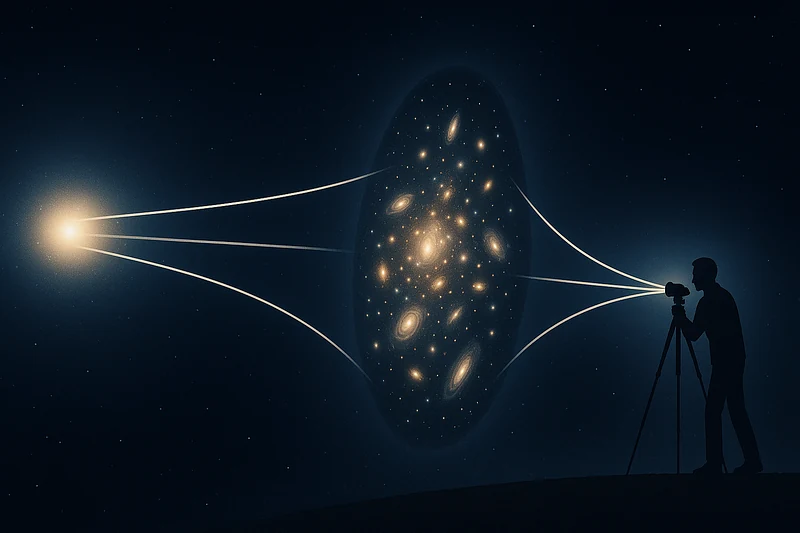
Gravitational lensing is when a massive object (like a galaxy cluster) bends light from a more distant object (like a quasar). Depending on the alignment, we see:
- Warped arcs
- Duplicate images
- Full circles (Einstein rings)
This isn’t a trick — it’s the same geodesic-following behaviour scaled up. The intervening mass acts like a lens, focusing or distorting the light.
Microlensing and Weak Lensing
There are different flavours of lensing:
- Microlensing happens when a smaller object, like a star or planet, passes in front of a distant star. The background star temporarily brightens, revealing planets or dark objects otherwise invisible.
- Weak lensing is a subtle distortion of background galaxies by large-scale structure — cosmic filaments, dark matter halos. It’s a statistical effect used to map dark matter and understand cosmic evolution.
Real Observations: Hubble’s Frontier Fields
The Hubble Space Telescope’s Frontier Fields program used massive galaxy clusters as lenses to magnify distant galaxies. This allowed astronomers to see some of the earliest galaxies in the universe, otherwise too faint to detect.
Gravitational lensing is not just a curiosity — it’s a powerful cosmic tool.
🎁 Bonus Real-World Applications
GPS and Relativity
GPS satellites orbit Earth and send timing signals to your phone. But because they’re in weaker gravity and moving fast, their clocks tick differently than clocks on Earth’s surface. Without correcting for gravitational time dilation and special relativity, GPS errors would accumulate at about 10 kilometers per day!
Einstein’s insights aren’t just academic — they’re embedded in the tech we use daily.
Gravitational Redshift in White Dwarfs
Light escaping a white dwarf star — a dense stellar remnant — loses energy climbing out of the strong gravitational field. This causes its light to shift towards the red end of the spectrum, a phenomenon called gravitational redshift.
Astronomers use this effect to measure the mass and radius of white dwarfs, testing models of stellar structure.
❌ Common Misconceptions
“Light Bends Like a Car Taking a Corner”
Nope. Light doesn’t “turn” like a car steering around a bend. Instead, the space it moves through is curved, so the straightest path itself is curved. It’s like walking straight ahead on a globe — you end up following a curve without changing direction.
“Curvature = Gravity Pulling”
Gravity in General Relativity isn’t a force pulling objects like a magnet. It’s the geometry of spacetime telling objects how to move. Mass and energy shape spacetime, and objects follow these shapes naturally.
🧠 My Take: The Universe Is a Curved Lie
So… does light ever travel in a straight line?
Only if spacetime is flat. Which it almost never is.
Even far from stars and planets, the cumulative curvature from cosmic structure — voids, filaments, dark matter — can bend light in subtle ways. We assume the straightest possible path is straight — but we don’t know for sure. That assumption underpins our entire interpretation of where things are, how fast they’re moving, and how old they are.
What if we’re wrong?
That’s where my mind went next:
If light is always curving, how can we trust redshift-distance calculations?
And
Could we be seeing the same object multiple times, from different angles?
Spoiler alert: That’s what Part 4 of this series explores in detail.
🧭 TL;DR for This Post
- Light doesn’t “choose” to curve — it follows geodesics through curved spacetime.
- Massive objects like stars and black holes bend spacetime, and light bends with it.
- Einstein’s equations predict this. Observations confirm it (1919 eclipse, Cassini, gravitational lensing).
- Even if space looks flat, subtle curvature is always present — and it affects what we see.
- “Straight” isn’t straight. It’s just as straight as spacetime allows.
Up next: Part 2 — “How Far is That Galaxy Really?” — where we dive into redshift, expansion, and the murky waters of cosmic distance.